THE DRAWING INDEX — SHT D
THE TEAM LIBRARY.
Documentation in Plansheet is a content-addressed lake, versioned the way source code is. Every document has a path, a history, and a place in one library the whole team reads from.
One library, addressed by path, versioned by commit.
ONE LIBRARY, ADDRESSED BY PATH, VERSIONED BY COMMIT.
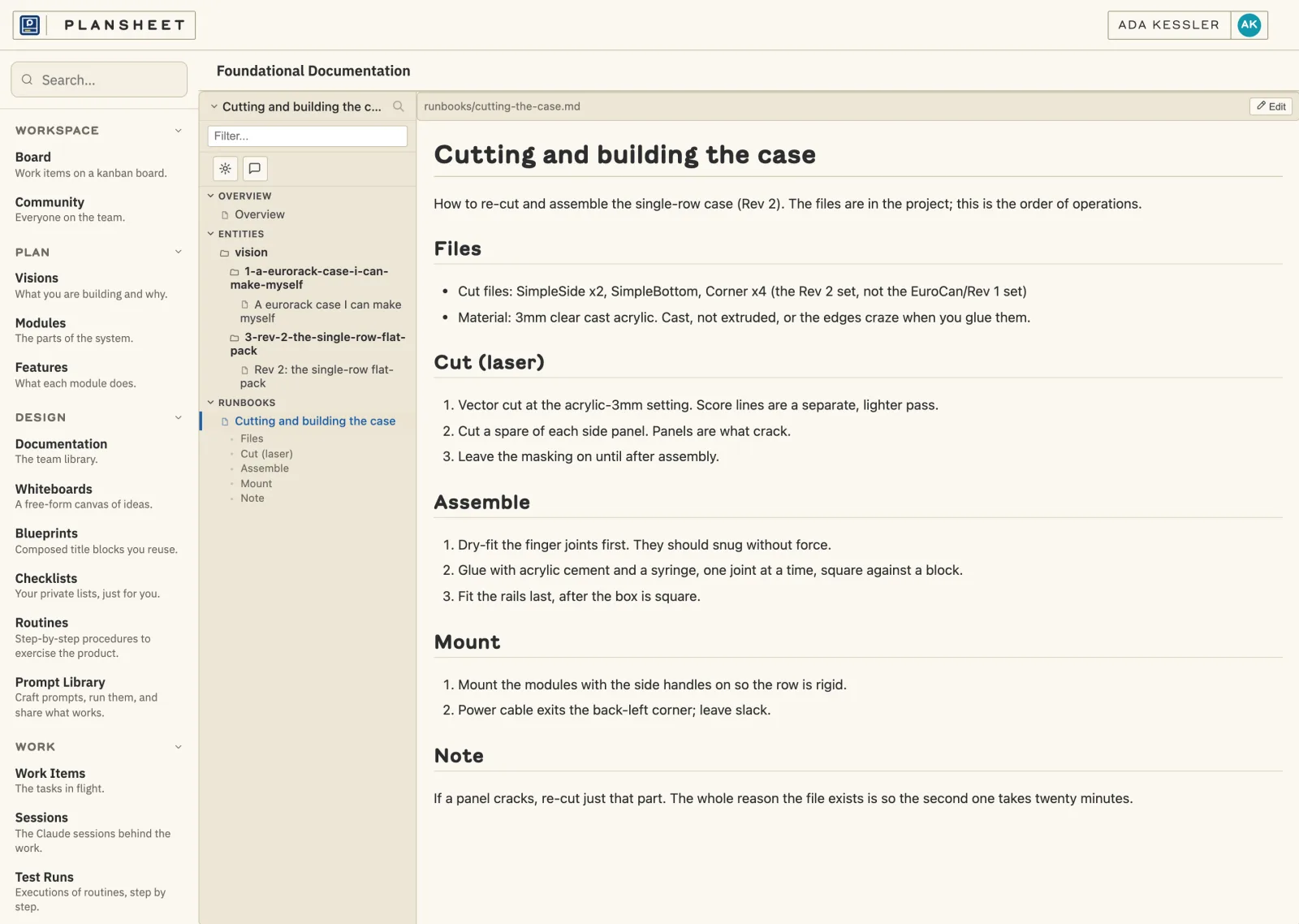
THE BUILD HOW-TO, KEPT IN THE LIBRARY NEXT TO THE WORK.
FROM A SYNTH CASE, MADE TWICE ->
DOCUMENTATION FIRST, NOT LAST
Documentation is not the thing you write after the work, if there's time. Which there never is. In Plansheet it is the work. Visions, modules, features, and work items all carry their documents. And the library is where a team goes to learn what they are making. The drafting table is already laid out to stand around; the name on our door is documentation-first for a reason.
VERSIONED LIKE CODE
The docs lake is content-addressed, the way a source repository is. Every change is a commit. You can read the history of a document, compare two versions, and recover anything, because edits are stored as sequential changes rather than overwrites. The library remembers each and every draft, not just the latest one.
A DOCUMENT WITH NO HISTORY IS A RUMOR.
RICH ENOUGH FOR THE REAL THING
Plain prose is rarely the whole design. So the editor handles markdown with images, typeset math via KaTeX, diagrams drawn with Mermaid, and full Excalidraw sketches that round-trip as editable scenes. You can get as close as possible to describing the intended design: equations and diagrams, the hand-drawn shapes, and the messy whiteboards. Not a thin summary of the design, or worse, a rumor.
WHAT THE LIBRARY HOLDS
01
FOUNDATIONAL DOCS
The references a team builds on, linked to the parts of the design they describe by path.
02
CORE DOCUMENTS
Long-form documentation for every vision, written where the whole team can see it.
03
MEDIA
Images, recordings, and drawings, connected to the thing they belong to.
04
HISTORY
Every action, with a timeline and a per-document comparison between any two versions.
THE PLACE A TEAM LEARNS WHAT IT IS BUILDING
GIVE THE WORK A LIBRARY
Write the design where anyone you want can read it. Version it. Keep every draft.
START DRAFTING BACK TO THE INDEX